
 It is hard to believe that another year is almost over. Two thousand and eighteen years have gone by since Jesus entered the world as a baby. Tomorrow we will begin a new year — 2019. 2018 was a milestone year for me as I marked 50 years of teaching and celebrated 50 years of marriage to my amazing wife. As I enter 2019, I find myself wondering what the new year will be like and what does God have in store for me, my family and my ministry.
Last week I was reading in the Psalms and a couple of verses jumped off the pages and caused me to stop and reflect for a moment. I read,
The days of our years are threescore years and ten (70); and if by reason of strength they be fourscore years (80), yet is their strength labour and sorrow; for it is soon cut off, and we fly away. Psalm 90:10 (KJV)
Of course, I gave this verse a close look because I find myself somewhere between threescore and ten and fourscore years. It is true that life here on earth is brief and passes by so quickly and the years are filled with labor and sorrow. I continued reading and paused at another very familiar verse.
So teach us to number our days, that we may apply our hearts unto wisdom. Psalm 90:12 (KJV)
It is important to pay attention to every single day that God gives us here on earth. As I numbered my days, I found myself humbled to have been blessed by God in so many ways over the years. God wants us to take careful account of our lives because that will cause us to acquire a heart filled with wisdom. When we do this, we would quickly realize that, apart from Him, we can accomplish nothing of eternal significance.
So how should we enter 2019? To answer this question, I want to reflect on two other verses that I read the other day. These are found in Psalm 92.
It is a good thing to give thanks unto the Lord, and to sing praises unto thy name, O Most High: to shew forth thy lovingkindness in the morning, and thy faithfulness every night, Psalm 92:1-2 (KJV)
Another translation says that we should declare God’s lovingkindness in the morning and His faithfulness at night. These verses have guided me over recent years on how to start and end each day as I number them. I wrote in the margin of my Bible next to verse 2 the following thoughts.
At the beginning of each day ‘look forward’ with HOPE!
At the end of each day ‘look back’ with THANKS!
When I start a day, I should focus on God’s never-ending lovingkindness. This gives me hope no matter what circumstances I might face throughout any given day. When the day ends and I look back on all that took place, I become thankful because I am always amazed that He was fully faithful to His Word. He never fails!
I believe this is a great way to not only start and end a new day but also how to start and end a new year! As we enter 2019, let’s do so declaring God’s lovingkindness. I am convinced that if we did this throughout 2019, when the year comes to an end and we look back, we would find that God was completely faithful and we would end the year with thanksgiving in our  hearts, singing praises to His name.
I encourage you to take a few minutes and reflect on 2018. I am sure that we all faced some minor and major challenges over the course of the year. There may have been a time when you may have wondered how you would even survive to see another day. As I look back on 2018, I can only give praise to the One who was with me each step of the way. What an amazing God we serve! I pray that God will show forth His lovingkindness to you each day of 2019.
Now unto God and our Father be glory for ever and ever. Amen. Philippians 4:20 (KJV)
 Have you ever received an email or text message that hit you hard and you couldn’t get it out of your mind? Well, that happened to me last week. I received a short email from a dear friend. In the email, he simply shared some questions with me. After reading it, I tried to move on with some work I had to do. However, those questions kept coming up in my mind and, no matter what I tried to do, I couldn’t stop thinking about them.
 There are some buzzwords and phrases that have caused me great concern over the past several years. I hear these words from leaders in churches, schools and other ministry organizations. When these statements are made, they really sound good and something we all should want to pay attention to. Some of these phrases include:
 All across the United States family and friends will gather together on Thursday for fellowship, fun and food. This is because the third Thursday of November is celebrated as Thanksgiving Day. There are several other countries that take time during the year to pause and give thanks for all of life’s blessings. Of course, Thanksgiving Day in America is set aside to give thanks to the Lord for all of the blessings He has bestowed on us throughout our 200+ years of history. Unfortunately, the true meaning of Thanksgiving Day has been lost in the busyness of football games, travel and, of course, Black Friday sales gimmicks. As with most Christian holidays in America, Thanksgiving Day has succumbed to the secular culture. In fact, some secular history textbooks present the first Thanksgiving as a time when the Colonists met and gave thanks to the Indians for their help as they settled in the New World. God is completely ignored.
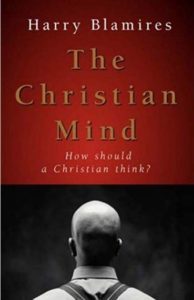 Upon returning home, I went to my bookshelves and pulled two books out that address this serious condition that we are facing in today’s Church. The first book was The Christian Mind: How Should a Chrisitan Think?, by Harry Blamires. As I opened the pages of this book, that I have read on a couple of occasions, I was taken captive by the first sentence in the book. It simply states, There is no longer a Christian Mind. Wow! Is Blarmires stating that Christians don’t have minds? Absolutely not. What he is proposing is that Christians no longer possess the ability to address all of life from a biblical perspective. In fact, Blamires states unashamedly that the Christian mind has succumbed to the secular drift with a degree of weakness unmatched in Christian History. He postures that, in Christianity, there is
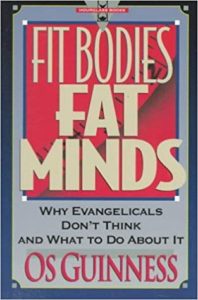 of the book is what really caught my full attention the other day. It reads, Why Evangelicals Don’t Think and What To Do About It. Again, I found myself asking the question, Is it true that Christians don’t think? Once again, I had to admit that all Christians think. That is a reality of life — human beings all think! So what was Guinness trying to say. His main premise is that the average Christian no longer has the ability to think Christianly. The result, according to Guinness is,

 because of sin and are bond slaves of Satan. When people, even Christians, forget God, they always end up in chains. As I have presented in earlier posts, the real danger of giving our children and youth a secular education is found in the fact that God is ignored in the entire process. Therefore, even though certain lessons may be factually accurate, God is not seen as being the source of wisdom and knowledge for any study and/or area of life that is studied. The student develops a secular worldview and lives his/her everyday life as if God doesn’t exist. This always results in imprisonment.
 John 17:3; Romans 1:20; Romans 11:33-36; Psalm 19:1-6; Ephesians 1:16-19; 3:15-19; 4:13; Philippians 1:9; 3:8-10, 13-14; Colossians 1:9-10; 2:2-3; 2 Peter 3:18; Proverbs 2:5; Hosea 4:1; 6:6; and 2 Corinthians 10:3-5
 culture rejects the fact that every person is created in the image of God and that life begins at conception (see Psalm 139:13-17; Jeremiah 1:5), human life ceases to have intrinsic value. Because Christians have not voted to protect the sanctity of human life we have witnessed:
 I recently saw where posters were placed on community trash cans that compared Christians to trash that needs to be kept off of city streets. Christians who choose to live out their faith in their private businesses have been harassed and even faced criminal charges.
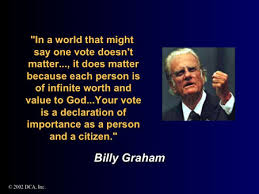 type of education should be to prepare them to be salt and light when they go out into the world as young adults. We can model this for our children to see by engaging in all areas of life – including politics – from a biblical worldview ourselves. This week talk with your children and let them know how privileged we are to live in a country where we can vote and why you vote in a certain way that will take God’s truth into the public arena.
 Every person forms a worldview. One’s worldview determines how he/she interprets all of life and, therefore, drives his/her everyday actions and attitudes. Depending on what definition one refers to, a worldview is determined by one’s beliefs about several key components such as:
Recent Comments