
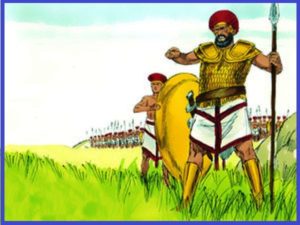
 One of my favorite historical accounts found in Scripture is that of David’s fight with Goliath. When you read about this confrontation in 1 Samuel 17, there are several points that are worthy of one’s consideration. David is at home taking care of the sheep while his three oldest brothers are with the Israelite army fighting the Philistines. I imagine that David must have dreamed about what it might be like to be on the battlefield instead of watching some smelly old sheep.
One day, his father gives him food supplies and sends him to check on the battle. David is to go and see how his brothers are doing and bring a report home to his father. David must have been excited to be asked to get the opportunity to go where the fighting was taking place. Scripture records that David got up early and hurried to the battle front. He dropped off the supplies and went looking for his brothers. As he approached the army of Israel his heart must have started racing as we find the following account taking place.
And he came to the camp as the army was going out to the fight and shouting for the battle. For Israel and the Philistines had drawn up in battle array, army against army. 1 Samuel 17:20-21 (NKJV)
These words paint a great picture of what David was about to experience. He arrived in time to see the army going out to fight. He could hear the shout of the soldiers in unison as they assembled in military formation. David probably thought to himself that he had arrived just in time to see the mighty Israelite army fight against its enemy, the Philistines.
Here an interesting twist takes place that caught David by surprise. David had found his brothers and was talking with them when a huge man, named Goliath, stood on the hillside opposite of where the Israelites had drawn up in military formation. David heard this man mock the army of Israel and, even worse, blasphemed their God. I wonder if the thought raced through his mind that God’s mighty army was going to rise up and take this evil person out. However, something unexpectedly took place. Instead of going to fight this giant, the Israelite army turned and ran away from him in fear. David was shocked. The entire army went and hid in their tents because of the threatening words of one man.
Again, I envision David becoming a flap flipper. David appears to go to the soldiers, flip the flap of their tents and start asking them what they were doing cowering inside their tents. This young teenager couldn’t believe that they were letting one man  mock the God of Israel and not standing up to him. This must have mystifying to David.
Then something else took place that may have caught David my surprise. David’s oldest brother catches up with him and says the following.
Why did you come down here? And with whom have you left those few sheep in the wilderness? I know your pride and the insolence of your heart, for you have come down to see the battle. 1 Samuel 17:28 (NKJV)
Instead of feeling guilty for not standing up for God and confronting Goliath, Eliab gets mad at David and accuses him of rocking the boat. In essence, David’s brother, wanted him to quit stirring up trouble and simply go back and tend their father’s sheep. After all, the Israelite army would get in battle formation and go through the military maneuvers on a regular basis. Whenever Goliath would raise his ugly head, they would break rank, go to their tents and wait until Goliath was through. Then they would gather again in formation and continue with their drills. Everything was fine. Goliath inflicted no actual harm and after his spewing of hatred toward God and His army, he would retreat and the army could go back to its normal routine.
It was at this point in the account when David said something that would bring everything to a head. The first thing he asked his brother was what had he done. This sounds like a typical teenager’s response to a sibling’s rebuke. But then David asked a second question,
Is there not a CAUSE? 1 Samuel 17: 29 (NKJV)
The word “cause” often referred to a decree or commandment. Many times its use conveyed the idea of divine communication. We can determine that what David was asking was, Hasn’t God said something about a situation like this? Doesn’t God expect His people do something when His name is being profaned in the way that Goliath was doing? We know that David was willing to take up this cause and ended up being the person that God would use to defeat Goliath.
In light of all of this, I see a similar situation taking place in God’s army, His church, today. If I were to go to the battle ground on any given Sunday, I would see a mighty fighting force gathering together and going through their military maneuvers. They would shout out in unison songs telling of the greatness of God and they would hear from some of their military leaders words of encouragement and the need to remain faithful to the Lord’s commands. There would be a sense of excitement as I experienced the worship that I would witness.
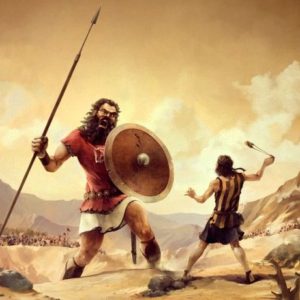 However, I would experience something like David experienced if I stayed around the week following the Sunday worship time. Then I would witness a giant come forth and start defying the God that Christians had just gathered to worship on Sunday. He would declare that this God wasn’t so great and even mock His existence. It would be at this point that if I were to start asking church leaders and other Christians why this was being allowed to take place, I would be told not to rock the boat. They might tell me that every Sunday they gathered together and would join in going through some dynamic military maneuvers. Then on Monday through Friday, this giant would come out and start mouthing off about God etc. However, by the end of the week, he would go back into his camp and God’s people would gather once again to sing, shout and hear the Word of God preached. No harm – no foul!
My question is, Is there not a CAUSE? Doesn’t God expect us to do something when His name if being profaned in the way this modern-day giant is doing? You may be wondering who is this giant I am writing about? Today’s giant that stands against God is secular education. Every day a vast majority of our children and youth listen and learn from this giant how man is the center of everything and God simply isn’t important or doesn’t even exist. God’s name is being profaned and yet, many of His people, don’t do a thing about it.
What was David’s cause or motivation that led him to be able to defeat Goliath on that memorable day? David’s cause is recorded in verse 46.
This day the Lord will deliver you into my hand, and I will strike you and take your head from you. And this day I will give the carcasses of the camp of the Philistines to the birds of the air and the wild beasts of the earth, that all the earth may know that there is a God in Israel. 1 Samuel 17:46 (NKJV)
As another school year comes to a close and many start planning for next year, I want to challenge Christians everywhere to recognize the cause for why we are in this battle. Our cause must be that future generations will know that there is a God in our lives, our homes, our churches and our schools. It is the only cause worth fighting for!
 that Dr. Ken Hemphill wrote about in his book, EKG: The Heartbeat of God. I was reminded that Jesus declared that the kingdom of God must be our highest priority in our lives, homes, churches and schools.
 This concept is also applicable to the education we give to our children and youth. Their education must be different from the secular education that this world provides. The difference must be evident in the school’s philosophy and the worldview from which all teaching takes place. However, we are facing a crisis in today’s homes, churches and schools. Hemphill accurately describes our current crisis this way.
 As another school year comes to close here in this country and we start preparing for a new year, I believe it is important that we take some time and reflect on God’s call on our lives, our homes, our churches and our schools. In light of what I have shared above, there are some questions that we need to consider.
 Last week I heard a sermon on the family that had a different twist to it. The text for the message was taken from Matthew 12:25 which reads:
 Unfortunately, most Christians suffer from double-mindedness! We have divided our lives up into two compartments — the secular and the sacred. Certain areas of life are controlled by a secular worldview. The “religious” areas of life are guided by a biblical worldview. The result is that there is no cohesiveness to our lives, our homes, churches, schools etc. This is not something that only exists in individuals’ minds. It is also prevalent in how we educate our children and youth. We take them to church on Sundays so that they know what the Bible says about life. Then, the majority of parents send their children to secular schools the rest of the week where the world tells them what life is all about. The result is that our children are being educated in double-mindedness and, therefore, are doomed for failure and destruction.
 course the only worldview that can provide this type of congruency is a biblical one. Until we teach our children at home, church and school that the value of human life is found in the reality that God created each person in His own image, we will never see a decrease in the senseless loss of human life that is so common in the world today. That is why I have spent the last couple of years developing resources that I pray will help Christian parents, church leaders and educators develop a biblical worldview. If we don’t unite the home, church and school and provide our children with a biblical worldview education, we will continue to see future generations grow up with divided minds. God’s Word says that when this occurs, they cannot stand; they will be brought to desolation!
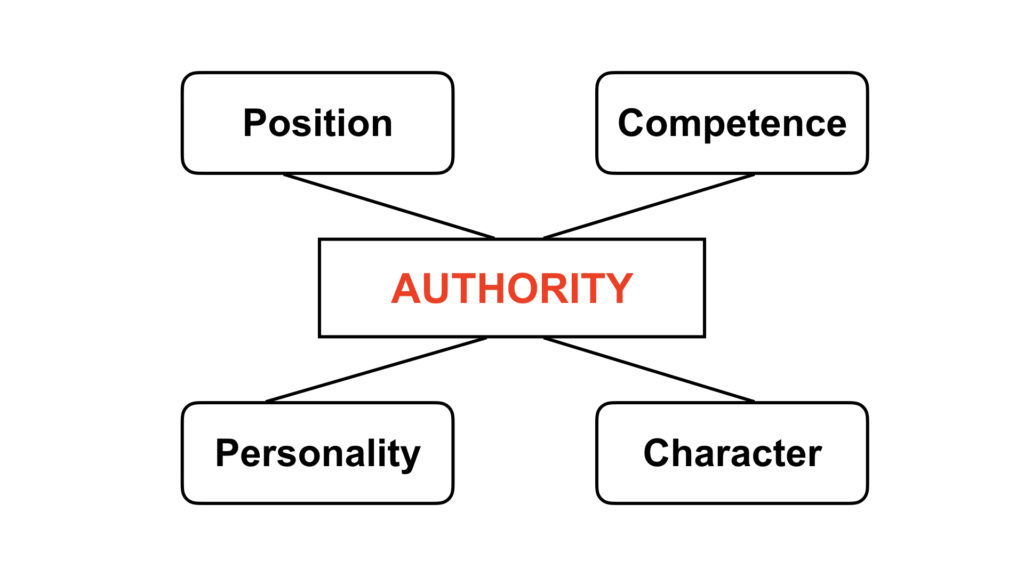 Position
 This is also very true when it comes to the exercise of one’s authority. If we are not trustworthy and honest with those we are trying to influence, it will hurt our ability to exercise effective authority over them. We must develop a strong credit rating with our children and/or students. We must live lies of integrity where we actually do what we say we will do.
 became parents. It wasn’t that they necessarily weakened their parental authority. They basically did nothing to strengthen it. They were like the unjust steward who hid his master’s talent in the ground. The result that comes with not strengthening one’s authority is that that person can actually lose any influence over the ones that God wanted them to lead. Sometimes a parent’s authority is taken away and given to another person or group.
 I have been highlighting the issue of authority and submission to authority in several of my recent blogs. I am giving so much attention to this subject because I believe it is so essential to Christians living a life that is pleasing to God. After all, every person is under some authority and everyone exercises some authority over someone else in some way or another.
 give what he/she owns to another person’s care. When I considered the many aspects of stewardship found in Scripture, I defined stewardship this way.
 No matter how much authority I might attain, I must always realize that I am not in charge. God is the only One who is sovereign and has all authority. Jesus made this clear when He stated,
 Over the past couple of weeks I have attempted to address the issue of authority and subjection from a biblical perspective. So far, we have seen how authority is set in place for the purpose of function not importance. Anyone who finds himself in a position of authority is not to think more highly of himself than those he is leading.
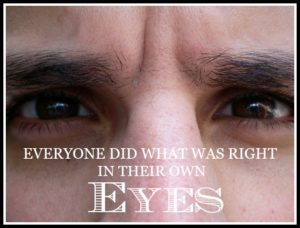 what he thought to be best. Sinful man’s condition can be summed up in the phrase that is found throughout the book of Judges.
 Do not be deceived, God is not mocked; for whatever a man sows, that he will also reap. Galatians 6:7
 was surprising so I asked them to explain it. Students explained when people in authority were not willing to set clear boundaries and hold them accountable to staying within those boundaries, they believed that their authority didn’t care about them. They got the sense that their authority, many times their parents, wanted to be “liked” by them and were more interested in their own comfort rather than the good of the child.
 If you want to get a good argument going, all you have to do is bring up the topics of authority and submission. Trying to discuss the importance of authority and submission in today’s culture is sure to ignite a lot of healthy and not-so-healthy debate. Yet, it is important to have a biblical understanding of these two words if any marriage, organization, or society is going to be able to survive. In fact, the reason we are such a divided country and why there is so much crime, corruption and mistrust in all aspects of life is because we have rejected all forms of authority that are necessary for a civilization to survive.
 submit to the Father’s will.
 all changed when sin entered the picture. In fact, the actual sin that Adam committed was the rejection of God’s authority in his life. By eating of the fruit that God had forbidden him to eat, Adam was rebelling against God’s authority to tell him what he should and/or should not do. In reality, all sin is some form or another of man’s refusal to submit to the will of God. It shows that man is determined to live his life by, in the words of Frank Sinatra, doing it MY way! (emphasis mine).
 important is because it also means that every time anyone in history has refused to submit to his/her authority, he/she has, in essence, rejected God’s authority in his/her life. This is specifically stated in Scripture when Israel demanded a king. God told Samuel that the people weren’t rejecting Samuel but were rejecting Him.
 I don’t ever remember when American culture was more divided. It seems that when topics such as government, public spending, regulations, social welfare, individual rights, and race or gender are discussed, there are two polarizing sides each claiming to be right. Even more disconcerting is the fact that each side claims that the other side is endangering our freedom and liberty. The two sides even claim that they are trying their best to “defend the US Constitution”.
 starting point. They are starting with the Constitution being the foundation stone for freedom and liberty.
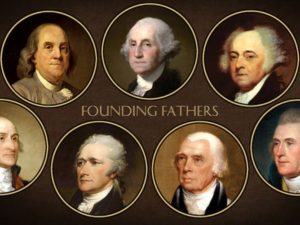 Of all the dispositions and habits which lead to political prosperity, religion and morality are indispensable supports. George Washington
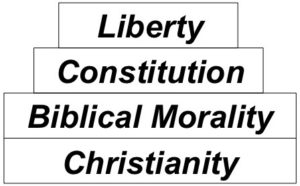 Unfortunately, these two cornerstones of liberty have been purged from our educational institutions today, from preschool through graduate school. Of course, this had to happen when Americans said that education must be secular and there had to be separation of church and state at all levels of public life, especially schooling. In last week’s blog, I showed how secular education may not directly attack God and/or the Bible. Instead, secular education simply says it is removing any “religious” bias or reasoning from learning. That is because secularists believe that religious/spiritual things are personal and subjective. There is no place for them in the public arena that is concerned only with “neutral” facts and knowledge.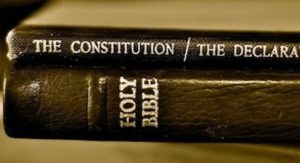
 I asked some questions in this week’s email blast. If you are reading this, you probably tried to answer these questions and want to know how you did. The three questions (along with the answers) I asked in my email were:
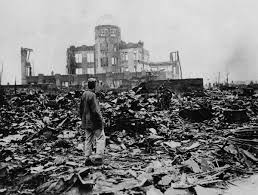 A young man named Kermit Beahan peered through the rubber eyepiece of the bombsight, and he could see some of the buildings of Kokura and the river that ran by the arms factory. But the complex itself was blocked by a cloud. So Bock’s Car gave up on Kokura and went on to its secondary target, Nagasaki. Clouds also partly obscured Nagasaki, but not quite enough of it.
 second battle.
 history (or any other subject where He is ignored). The result from this type of dualistic thinking and teaching is that young people end up believing that Christianity does not provide answers to life’s big questions. Ken Ham in his book, Already Gone, discovered this dilemma when he talked with young adults who left the church soon after high school graduation. These young adults said,
 challenges in the days ahead. These challenges are a result of society’s move away from biblical principles guiding their decisions.
 its intensity in recent years. In fact, Meyer’s book was written in 2008. We are now reaping the consequences of not addressing these issues for many years. This brings me to the crisis facing today’s parents and the education of their children. The article I was reading stated that Americans [parents] right now are so busy that they really don’t invest very much in trying to understand everything that’s going on around them…in fact, they don’t invest much at all in trying to discern truth. Pay careful attention to what Barna actually said.
 How does all of this bode for future generations across the land? It does not bode well for future generations because Millennials are America’s primary parenting generation today according to Barna. If our hope is to see our children and youth develop a biblical worldview and change the direction we are going in, we have to ask ourselves the question, Where will they get a biblical worldview from? If only 4% of the primary parenting generation has a biblical worldview, their children have little chance of developing one on their own. Barna put it this way.
Recent Comments