
 Last week I shared how the majority of parents, church leaders and teachers believe that the main purpose of schooling is to prepare students for more schooling! They may not articulate this as the main purpose of schooling but in practice this is the reality. As a new school year begins, I believe it is important that Christians develop a few key objectives that should drive the education we give our children at home, church and school. It is essential that these objectives are achieved if we are going to fulfill God’s purpose for education and correctly prepare our children for the future.
Goal #1: Our Children Must Increase In Their Knowledge of God
There is no doubt about it. All education involves the acquisition of knowledge. However, too much of our educational efforts have to do with gaining more facts about a wide variety of topics. Unfortunately, most of this effort to know more “stuff” does not provide our children with the God-intended meaning behind all the facts they are taught. John Piper explains why just knowing the facts about something isn’t real education.
Modern people suppose that if they have the facts about a given thing, person, or event, they have the truth. They forget that facts are not meaningless or value free, and that if we do not associate the meaning with the fact, we do not have the truth.
J. I. Packer reminds us of why God created man in His image. He wrote,
Once you become aware that the main business you are here for is to know God, most of life’s problems fall in place of their own accord.
All of the teaching that we give our children should aim at increasing their knowledge and understanding of who God is. This is what the Psalmist referred to in Psalm 19:1-4 and Paul was saying in Romans 1:20. Everything our children study is part of God’s creation and should tell them something about who God is. The late Albert Greene understood this when he wrote,
We must avoid the impression that academics represents the fullness of what school is all about. Knowing God in and though the creation is what is important…It brings no honor to the Holy Spirit if we then proceed to treat the ordinary school studies, which are derived totally from the created world, as if they had nothing to do with God. They are laden with meaning because they are all part of God’s way of giving Himself to us, of making Himself known to us.
Are your children increasing in the knowledge of God through their total educational experience? If not, we aren’t preparing them for the real future.
Goal #2: Our Children Must Hear God’s Call
In past posts I have shared how God places two calls on individuals. The first call that God gives to all people is His call for them to be saved. Scripture tells us that God is long-suffering because He does not want anyone to perish. However, God also gives each person a specific call. This is God’s call to a work or vocation. We have lost the concept of vocation in today’s world. Tim Keller explains this in his writings when he states,
We must recover the idea that work is a “vocation” or calling, “a contribution to the good of all and not merely…a means to one’s own advancement.”…Something can be a vocation or calling only if some other party calls you to do it, and you do it for their sake rather than your own. Our daily work can be a calling only if it is reconceived as God’s assignment to serve others.
When the main purpose of schooling is merely preparing our children for more schooling, they may go through twelve or more years of schooling without ever understanding God’s purpose for their existence. Kevin Swanson puts it this way.
A successful education is achieved when a child is prepared to make maximal use of his God-given talents and abilities in the accomplishment of the child’s calling…The challenge of the first eighteen years of a child’s education is to find that calling…A fulfilled life will be determined by whether he/she has centered in upon his/her calling.
Do your children understand how God has gifted them with certain talents and abilities? Are they sensitive to God’s call on their lives? This has to be part of every child’s education from infancy all the way to maturity.
Goal #3: Our Children Must Pursue Biblical Excellence
In order to pursue true excellence, one must believe that there are absolute standards by which excellence is measured. Unfortunately, today’s culture refuses to believe that there are absolute standards for anything, including excellence. This means that excellence is totally relative and is only looked at from a horizontal perspective. This results in people pursuing an excellence that is only based on “comparison” and “competition”. One achieves excellence by being better or beating everyone else. Even today’s western church has adopted this concept of excellence.
A biblical understanding of excellence begins by setting God, Himself, as the true standard of excellence. Jesus is our model of excellence and our goal is to be like Him (1 John 2:6). Biblical excellence requires that the primary focus must be on character rather than performance or achievement. Our motive to be excellent in all things is to glorify God (1 Corinthians 10:31). Gary Inrig explains how excellence in character is more important than mere perfection in performance.
…excellence of character rather than excellence of achievement must be the central concern of the believer…the priority of character is due to the fact that what a person is colors all that he does.
Performance takes on eternal significance when it is an extension of one’s godly character. Consider the words of Darrow Miller.
Because redeemed man is working for God, to fulfill God’s plans, the work is to be done with excellence. Our guidelines for excellence are found in God’s own nature. God is true, just, and beautiful. Our work, in both its means and ends, is to manifest truth, justice, and beauty.
Is the education you are giving your children teaching them that excellence is all about out-performing others? Are you educating your children in a way that challenges them to pursue excellence of character which will result in their best performance possible for God’s glory? We must realize that God’s excellence is not based on what He does but on who He is. That is why He expects us to be holy because He is holy!
These objectives must define and drive the education we give our children at home, church and school. If we do not achieve these objectives, our children will not be prepared for the future — regardless of what else they might learn!
Next week I will be spending time with my family over the Labor Day weekend. Therefore, I will not be posting an article next Monday. I look forward to being back with you on September 10th. I pray your Labor Day will be a blessed one.
 Over the past 2.5 weeks, I have had the privilege of conducting professional development seminars for nearly 700 administrators, teachers and parents from 15 different schools around the country. During these sessions I asked a series of questions to which I received nearly unanimous answers. As we discussed the purpose of education, I asked each group a simple question. What does preschool education prepare the children for? Without hardly any hesitation everyone in the session replied, Preschool education prepares children for kindergarten. From this response, I concluded that parents and educators believe that all education is an effort to prepare children for something that they see as important in the future. With everyone in agreement on this answer, I proceeded to ask a progression of additional questions. Here are the questions and the answers I received.
 get a good education, you will always get a strong YES. However, when you ask them why they want their children to have the best education possible, the most common answer you will receive is so that they can get into a good college. In other words, schooling has become an unending process of preparing our children for more schooling. It is no wonder that so many graduates leave high school with no real purpose for their lives — other than to go to college.
 I am amazed at how every person desires to live as long as possible. Even the atheist wants to go on living though he says that he doesn’t fear death. Whenever some disaster takes place such as hurricanes, earthquakes, or a terrorist bombing, every news station gives full coverage to the rescue efforts and the search for survivors. Just recently there was daily news broadcasts that chronicled the rescue efforts of a boys’ soccer team that was trapped in a cave due to a flash flood. This striving for life from when a newborn gasps for his/her first breath to when someone takes his/her last breath, the desire to live forever is a part of what it means to be human.
 Man has the amazing ability to create pictures in the mind and then bring into reality what was imagined. We see man’s creativity in manufacturing, art, literature, music, humor and the common activities of everyday life. Every parent has probably experienced what happens when he/she purchases a nice gift for a child only to find the gift set aside and the child playing with the box the gift came in.
 important fact to keep in mind because the education we give our children will play a big role in determining what type of culture our children and youth will create. Miller explains it this way.
 Today there are two dangerous extremes that people exhibit when it comes to looking at the topic of “work.” One extreme is to view work as something evil and, thus, something to avoid as much as possible. This view of work can be seen in how people dread Monday mornings, get some relief when “hump day” (Wednesday) comes and celebrate Friday’s with a shout of TGIF. When work if viewed as something that is a burden, the goal of work becomes making enough money to retire comfortably as soon as possible.
 One of the most important aspects of understanding what it means to be human is to grasp the reality that God created man to worship. When we hear the word worship today, many Christians immediately think of a style of music in the church. However, worship has a much deeper meaning than just one part of a church service. Webster’s 1828 Dictionary defines worship as to adore; to pay divine honor to; to reverence with supreme respect; to honor with extravagant love and extreme submission. Another definition that combines all of these aspects of worship together states,
 It is hard to comprehend how mixed up society is today. A major point of controversy is being battled over one’s gender. It has even gotten to the point that some “experts” claim that one’s sex is biological but one’s gender is a choice. One’s gender is determined by one’s feelings. In fact, some parents have even chosen not to identify the gender of a newborn baby because they want the child to be able to choose whatever gender he/she wants to be. Again, the issue at the bottom of all this craziness is determined by what it means to be a human being.
 In order to fully grasp what it means to be created in the image of God, we must understand that God created man for relationship. The doctrine of the Trinity is a crucial foundation stone of Christianity. The Father, Son and Holy Spirit are three separate persons in the Godhead. I cannot fully understand this reality with my finite mind. However, I can understand that God is a relational God. The Father, Son and Holy Spirit have always and will always be in perfect fellowship with one another. In Genesis 1:26, the Father tells the Son and the Holy Spirit let us make man in OUR image. Since God is a relational God and man is created in His image, then man was created to relate!
 In order to understand what it means to be human, we have to go back to the beginning of human history. Even though the world tries to convince us that man is merely a mechanistic organism that is the result of billions of years of evolutionary change, the reality is that man was designed in the mind of God and created by the Word and will of God. In Genesis 1 we find these words.
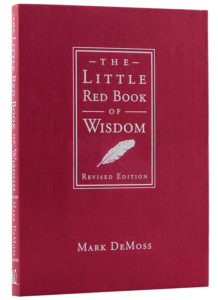 I have a book on my shelf that I take down a couple of times each year. The book was written by a young man that I first came to know while serving at Lynchburg Christian Academy. The book’s title is The Little Red Book of Wisdom. This small book as several short chapters that provide Christians will some keys on how to obtain true wisdom. Mark learned these nuggets of wisdom from his father and others who God used to influence his life.
 something that happens when I start every morning spending time with the Lord. When I open God’s Word and let Him speak to me, it changes my perspective on what I am facing at that particular time. It also prepares me for what God has in store for my life that day — many times it’s things that I don’t even know are going to take place.
 A lot of Christians that I know are very faithful in giving God the first hour in every day. However, this second Wisdom of Firsts is one that many of us, especially those of us in full-time ministry, struggle with. It is also important to give God the first day of every week. I know that you might be thinking that you do that. You may be one who never misses a Sunday going to church. In fact, you may even use your gifts on Sunday in service at your church. However, I am not talking about giving God the first morning of every week.
 quaint establishments that have various things on the walls or shelves that are reminders of how the business started and grew over the years. One of the items I have seen on walls of private businesses many times is a small picture frame with a dollar bill encased inside. It represented the “first” dollar that the original owner made in the business.
Recent Comments