
 All across the United States family and friends will gather together on Thursday for fellowship, fun and food. This is because the third Thursday of November is celebrated as Thanksgiving Day. There are several other countries that take time during the year to pause and give thanks for all of life’s blessings. Of course, Thanksgiving Day in America is set aside to give thanks to the Lord for all of the blessings He has bestowed on us throughout our 200+ years of history. Unfortunately, the true meaning of Thanksgiving Day has been lost in the busyness of football games, travel and, of course, Black Friday sales gimmicks. As with most Christian holidays in America, Thanksgiving Day has succumbed to the secular culture. In fact, some secular history textbooks present the first Thanksgiving as a time when the Colonists met and gave thanks to the Indians for their help as they settled in the New World. God is completely ignored.
Even though it is good to take one day each year to give thanks to the Lord for all of His rich blessings on our lives, thanksgiving should be a way of life for the Christian. It isn’t supposed to be something we just do on a national holiday. Paul makes this clear in many of his letters in the New Testament. Two specific verses come to my mind when I think about being thankful for what God does for me each and everyday.
In every thing give thanks: for this is the will of God in Christ Jesus concerning you. 1 Thessalonians 5:18 (KJV)
Be careful for nothing; but in every thing by prayer and supplication with thanksgiving let your requests be made known unto God. Philippians 4:6 (KJV)
Recently I sat down and started thinking about how much God has done for me over the course of my life. Let me share a few of the things for which I am thankful to God.
My Salvation
Sad to say, there are too many days that I allow the urgent to take control of my life and I find myself not consciously being aware of the tremendous price God paid for my salvation. It goes beyond any human comprehension that the Creator of the universe would give His only Son as a ransom for my sin debt. When I think about what Christ did for me by laying down His life to redeem me out of sin, it continually amazes me. It is my desire to never take my salvation for granted but to give God thanks each and every day for this precious gift.
My Family
Next month my wife and I celebrate 50 years of marriage. Like every marriage, there have been those rough days through which we had to navigate. But God blessed me with a godly wife who has supported me in everything that God has led me to do. God also has blessed the two of us with three wonderful children, their spouses and six fantastic grandchildren. Again, it hasn’t always been smooth sailing but 3 John 4 is so true — There is no greater joy than to hear that your children walk in truth. I thank God everyday that my three children are walking in truth today.
My Pastors
Sometimes we fail to take time to thank God for the people that God brings into our lives to guide us in the paths He wants us to walk. I have been overwhelmingly blessed by several pastors who have taught me truth that equipped me for life and ministry. Spending 16 years under the preaching and leadership of Dr. Jerry Falwell taught me what true faith in God is and how to live by faith each day. Then sitting under the teaching of Dr. James Merritt and Dr. Glenn Weekly took be deeper into the truths of Scripture. I also had the privilege to serve with Dr. Michael Catt for nine years at Sherwood Baptist Church. God used Michael to teach me the importance of prayer in my daily life. I have also been blessed by the friendships that I have forged with Pastor Mike Lewis at Cathedral of Praise and Pastor James McMenis at Word of God Ministries. These two men have provided me with biblical counsel and guidance so that my life and ministry would stay focused on Christ. God has truly blessed me by allowing me to sit under the preaching of such godly men. One day is not enough to thank Him for providing me with these ministers of God’s Word.
My Mentors
I have also been privileged to serve under and glean from several Christian educators who helped me form a biblical worldview and biblical philosophy of life. I probably would not have survived being a school leader if it weren’t for the guidance and instruction that I received regularly from Dr. Roy Lowrie, Dr. Jack Layman, Dr. Tony Fortosis, Dr. Gene Garrick, and others. These men had gone through the trials of leadership and were a source of encouragement and always provided me with a model for what Christ-like, servant leadership looked liked. A special note of gratitude must go to Dr. Paul Kienel. He had the courage to take a young Christian school administrator and give him the opportunity to serve Christian schools in 8 Southeast states as Southeast Regional Director of ACSI. Much of my understanding of kingdom education resulted from Dr. Kienel’s exhortation for me to present a biblical philosophy of education to others. Again, one day a year is not enough time to thank God for these and other mentors that He has brought into my life over the years.
My Ministry
I have to start by saying that Kingdom Education Ministries really isn’t my ministry — it is His ministry that He allows me to be a part of. If it were not for God’s leading me that took me to LifeWay Christian Resources, my book, Kingdom Education, would never have been written. It blows my mind how this little book has been used all around the world to challenge parents, church leaders and Christian educators to follow God’s plan for educating future generations. Anything I may have been able to accomplish in proclaiming this message to others is due only to the grace of God. I fully understand the meaning of Jesus’ words in John 15 where His said, without Jesus I can do NOTHING!
My Encouragers
Who are my encouragers? They are those who receive and read this blog each week. YOU are one of my encouragers and you do not know what a tremendous blessing you are are to me as you read and share my weekly ramblings with others who want to provide a biblical worldview education to as many children and youth as possible. There is not a day that goes by that God doesn’t bring to my mind a school leader, a pastor, teacher or fellow laborer in ministry that I have had the privilege of serving and getting to know. You are in the trenches doing the “grunt” work of putting kingdom education into practice and for that I am eternally indebted and grateful.
I could go on and on listing things for which I must daily give thanks to God. However, my point for doing this is to encourage all of us to always be thankful for God’s blessings on our lives. No matter what you and I may face, the truth is that God is at work to make all things good for His glory. If you live where a specific Thanksgiving Day is observed, by all means take the time to give Him the praise He deserves. But more importantly, in every thing give thanks: for this is the will of God in Christ Jesus concerning you. Have a blessed week!
 Upon returning home, I went to my bookshelves and pulled two books out that address this serious condition that we are facing in today’s Church. The first book was The Christian Mind: How Should a Chrisitan Think?, by Harry Blamires. As I opened the pages of this book, that I have read on a couple of occasions, I was taken captive by the first sentence in the book. It simply states, There is no longer a Christian Mind. Wow! Is Blarmires stating that Christians don’t have minds? Absolutely not. What he is proposing is that Christians no longer possess the ability to address all of life from a biblical perspective. In fact, Blamires states unashamedly that the Christian mind has succumbed to the secular drift with a degree of weakness unmatched in Christian History. He postures that, in Christianity, there is
 of the book is what really caught my full attention the other day. It reads, Why Evangelicals Don’t Think and What To Do About It. Again, I found myself asking the question, Is it true that Christians don’t think? Once again, I had to admit that all Christians think. That is a reality of life — human beings all think! So what was Guinness trying to say. His main premise is that the average Christian no longer has the ability to think Christianly. The result, according to Guinness is,

 because of sin and are bond slaves of Satan. When people, even Christians, forget God, they always end up in chains. As I have presented in earlier posts, the real danger of giving our children and youth a secular education is found in the fact that God is ignored in the entire process. Therefore, even though certain lessons may be factually accurate, God is not seen as being the source of wisdom and knowledge for any study and/or area of life that is studied. The student develops a secular worldview and lives his/her everyday life as if God doesn’t exist. This always results in imprisonment.
 John 17:3; Romans 1:20; Romans 11:33-36; Psalm 19:1-6; Ephesians 1:16-19; 3:15-19; 4:13; Philippians 1:9; 3:8-10, 13-14; Colossians 1:9-10; 2:2-3; 2 Peter 3:18; Proverbs 2:5; Hosea 4:1; 6:6; and 2 Corinthians 10:3-5
 culture rejects the fact that every person is created in the image of God and that life begins at conception (see Psalm 139:13-17; Jeremiah 1:5), human life ceases to have intrinsic value. Because Christians have not voted to protect the sanctity of human life we have witnessed:
 I recently saw where posters were placed on community trash cans that compared Christians to trash that needs to be kept off of city streets. Christians who choose to live out their faith in their private businesses have been harassed and even faced criminal charges.
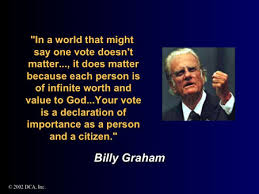 type of education should be to prepare them to be salt and light when they go out into the world as young adults. We can model this for our children to see by engaging in all areas of life – including politics – from a biblical worldview ourselves. This week talk with your children and let them know how privileged we are to live in a country where we can vote and why you vote in a certain way that will take God’s truth into the public arena.
 Every person forms a worldview. One’s worldview determines how he/she interprets all of life and, therefore, drives his/her everyday actions and attitudes. Depending on what definition one refers to, a worldview is determined by one’s beliefs about several key components such as:
 There is a passage of Scripture that has been on my mind for the past several weeks. It is found in James’ letter to the Christians who had been scattered due to persecution. It reads,
 We have been looking at what happened when one city decided to change its source from where it was getting its water. I want to remind you that the main reason why the city of Flint, Michigan wanted to change from getting its water from Detroit was to same money. If they would use the water that was right there in their backyard, they would save approximately $5 million. However, the contaminated water that came from the new source would cost much more than what they had hoped to save. After a mere 18 months of using the contaminated water, the cost of such a disastrous decision was and is still rising. Consider the following:
 If you are joining the conversation new, I encourage you to read the first two posts in this series. The first one was
  When the city officials of Flint, Michigan made the fatal decision to change the source of their water, there were concerns as to the wisdom of this decision. Some residents were leery about this move, wondering about the quality of the water. For the next several months a major cover-up took place by city and state officials. To ease the residents concerns, city officials issued several statements.
 On April 25, 2014 a city in Michigan made a decision that would end up devastating the city’s entire population. The city was Flint, Michigan and the disaster is known as The Flint Water Crisis. The decision that was made by the leaders of Flint, Michigan on that dreadful day actually started a couple of years earlier.
Recent Comments