
 Over the past couple of weeks I have attempted to address the issue of authority and subjection from a biblical perspective. So far, we have seen how authority is set in place for the purpose of function not importance. Anyone who finds himself in a position of authority is not to think more highly of himself than those he is leading.
We also looked at how submission to authority is not a negative thing but something that is good. This is because even Jesus lived a life of full submission to His Father. In fact, the degree to which I submit to the authority God places over me determines how Christlike I am becoming.
Since God establishes authority which, in turn, requires submission to authority, why is there such a problem with all of this throughout civilization? All one has to do is look at what is going on in governments around the world or in everyday life to see that there is constant resistance, rejection and even rebellion to any and all forms of authority. The answer to this dilemma is two-fold.
First, we must understand that because of the Fall, the flesh never wants to submit to any authority. The flesh wants to be completely autonomous. This is what led to sin in the first place. Adam rejected God’s authority in his life and chose to do 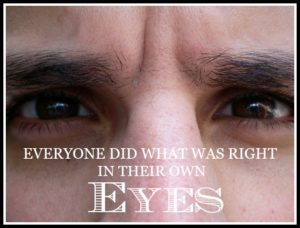 what he thought to be best. Sinful man’s condition can be summed up in the phrase that is found throughout the book of Judges.
In those days there was no king in Israel; everyone did what was right in his own eyes. Judges 17:6
No one wants a king in his life. I believe that is why people will continue to believe in evolution when everything in the universe shouts of a creator. If man admits that there is a supernatural being who created everything, then man must also admit that he is accountable to Him.
The second reason why I believe that just about all institutions of authority are being rejected has to do with how people exercise their authority. This is true in the family, church, education, government and society in general. The Bible speaks a great deal of how important it is for people to submit to authority. However, many Christians don’t give much heed to what the Bible says about how one is to exercise his/her authority.
Over the past few years, I have given a great deal of thought into a very familiar passage of Scripture. I have found this verse to have significant meaning on just about every aspect of my life. I am sure you probably have memorized this verse and quoted it at one time or another.
 Do not be deceived, God is not mocked; for whatever a man sows, that he will also reap. Galatians 6:7
Too often, we apply this to what happens when we commit sin. If we sow to the flesh, we will reap corruption. However, I have been convicted lately about the fact that this verse applies to every aspect of my life. Being a teacher and a coach, I always wanted my students to pay attention to what I was presenting in a lesson or trying to execute in a practice. I would get frustrated and sometimes angry if students weren’t paying attention or not putting forth the expected effort.
Then I was confronted with how I was paying attention or putting forth effort when listening to the preaching of God’s Word in a church service or sitting in a lecture or some staff development training in my job. I had to admit that many times I didn’t pay attention the way I should have. This was especially true when I found myself thinking that what someone else was saying wasn’t what I thought was all that important. The thought hit me that when my students didn’t pay attention to me was I simply reaping what I had sown when I was in the role of being a student?
So it is with the exercise of one’s authority. I will reap the consequences of what I sown in how I exercise any authority that God gives me. If I “lord it over” those I am to lead, then I will reap anger and resistance from them. If I am always “threatening” others, I will reap a challenging spirit from those I am trying to lead.
God taught me a very valuable lesson related to how He expects us to exercise authority that He gives us. I was teaching a Bible ethics class at a Christian school. We were studying a series of biblical principles that were to guide us in making decisions. Everything was going fine until we got to the principles of authority and submission/obedience. As soon as I announced the topic the students reacted negatively. Their mindset was that is all they ever hear — obey, obey, obey!
I knew that they needed to understand authority and submission/obedience if they were going to go out and live successful lives. I took them to two passages of Scripture and asked them a question related to each verse. These two verses were:
…ye fathers, provoke not your children to wrath: but bring them up in the nurture and admonition of the Lord. Ephesians 6:4
Fathers, provoke not your children to anger, lest they be discouraged. Colossians 3:21
Here are the two questions that I asked them.
- What does your authority [parents] do that causes wrath in your life?
- What does your authority [parents] do that brings discouragement in your life?
Their answers were convicting. They told me that when someone in authority is dictatorial or authoritarian in how he/she exercises their authority, it created anger and wrath in their lives. The attitude that says I am the boss, do what I say, because I say so resulted in angry reactions from these students.
Then they told me that what caused discouragement in their lives was when people in authority were too lenient. This answer  was surprising so I asked them to explain it. Students explained when people in authority were not willing to set clear boundaries and hold them accountable to staying within those boundaries, they believed that their authority didn’t care about them. They got the sense that their authority, many times their parents, wanted to be “liked” by them and were more interested in their own comfort rather than the good of the child.
Both of their responses dealt with “how” one exercises his/her authority — not with the fact that they “had” authority over them. There are several passages of Scripture that gives us guidance in how we are to exercise authority over those we are to lead. It would be good if we studied these passages and lived them out in our daily interactions with others. I have listed some of the passages I have found helpful.
- Matthew 5:3-11 – the Beatitudes which I see as “the attitudes it takes to be something in God’s kingdom.”
- Ephesians 6:9
- 1 Peter 5:1-3
- Mark 10:36-45
- Colossians 4:1
What do these verses tell you about how you are to exercise your authority? What other verses have you found helpful in being a servant leader? Leave your comments below.
 If you want to get a good argument going, all you have to do is bring up the topics of authority and submission. Trying to discuss the importance of authority and submission in today’s culture is sure to ignite a lot of healthy and not-so-healthy debate. Yet, it is important to have a biblical understanding of these two words if any marriage, organization, or society is going to be able to survive. In fact, the reason we are such a divided country and why there is so much crime, corruption and mistrust in all aspects of life is because we have rejected all forms of authority that are necessary for a civilization to survive.
 submit to the Father’s will.
 all changed when sin entered the picture. In fact, the actual sin that Adam committed was the rejection of God’s authority in his life. By eating of the fruit that God had forbidden him to eat, Adam was rebelling against God’s authority to tell him what he should and/or should not do. In reality, all sin is some form or another of man’s refusal to submit to the will of God. It shows that man is determined to live his life by, in the words of Frank Sinatra, doing it MY way! (emphasis mine).
 important is because it also means that every time anyone in history has refused to submit to his/her authority, he/she has, in essence, rejected God’s authority in his/her life. This is specifically stated in Scripture when Israel demanded a king. God told Samuel that the people weren’t rejecting Samuel but were rejecting Him.
 I don’t ever remember when American culture was more divided. It seems that when topics such as government, public spending, regulations, social welfare, individual rights, and race or gender are discussed, there are two polarizing sides each claiming to be right. Even more disconcerting is the fact that each side claims that the other side is endangering our freedom and liberty. The two sides even claim that they are trying their best to “defend the US Constitution”.
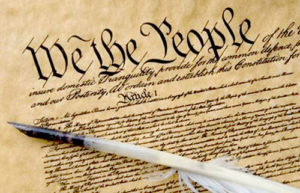 starting point. They are starting with the Constitution being the foundation stone for freedom and liberty.
 Of all the dispositions and habits which lead to political prosperity, religion and morality are indispensable supports. George Washington
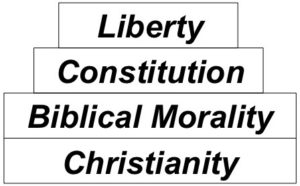 Unfortunately, these two cornerstones of liberty have been purged from our educational institutions today, from preschool through graduate school. Of course, this had to happen when Americans said that education must be secular and there had to be separation of church and state at all levels of public life, especially schooling. In last week’s blog, I showed how secular education may not directly attack God and/or the Bible. Instead, secular education simply says it is removing any “religious” bias or reasoning from learning. That is because secularists believe that religious/spiritual things are personal and subjective. There is no place for them in the public arena that is concerned only with “neutral” facts and knowledge.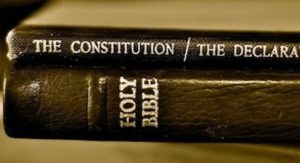
 I asked some questions in this week’s email blast. If you are reading this, you probably tried to answer these questions and want to know how you did. The three questions (along with the answers) I asked in my email were:
 A young man named Kermit Beahan peered through the rubber eyepiece of the bombsight, and he could see some of the buildings of Kokura and the river that ran by the arms factory. But the complex itself was blocked by a cloud. So Bock’s Car gave up on Kokura and went on to its secondary target, Nagasaki. Clouds also partly obscured Nagasaki, but not quite enough of it.
 second battle.
 history (or any other subject where He is ignored). The result from this type of dualistic thinking and teaching is that young people end up believing that Christianity does not provide answers to life’s big questions. Ken Ham in his book, Already Gone, discovered this dilemma when he talked with young adults who left the church soon after high school graduation. These young adults said,
 challenges in the days ahead. These challenges are a result of society’s move away from biblical principles guiding their decisions.
 its intensity in recent years. In fact, Meyer’s book was written in 2008. We are now reaping the consequences of not addressing these issues for many years. This brings me to the crisis facing today’s parents and the education of their children. The article I was reading stated that Americans [parents] right now are so busy that they really don’t invest very much in trying to understand everything that’s going on around them…in fact, they don’t invest much at all in trying to discern truth. Pay careful attention to what Barna actually said.
 How does all of this bode for future generations across the land? It does not bode well for future generations because Millennials are America’s primary parenting generation today according to Barna. If our hope is to see our children and youth develop a biblical worldview and change the direction we are going in, we have to ask ourselves the question, Where will they get a biblical worldview from? If only 4% of the primary parenting generation has a biblical worldview, their children have little chance of developing one on their own. Barna put it this way.
 I was on a flight to the Answers in Genesis’ Creation Museum to speak at a worldview conference. Since this was my first flight in March, I picked up the current issue of Sky Magazine to see if there was anything interesting in it. As I glanced at the cover, my attention was drawn to a headline. On the cover of this issue of of the magazine was a picture of Oprah Winfrey. Next to her picture in bold letters I read these words, Living Her Truth. Of course, I was intrigued and quickly turned to this lead article. When I arrived at the article, the title page captured my full attention. The entire page was a strong shade of red. There was a large O with the words of the article’s title inside the O. The title read The Wisest Woman in the World.

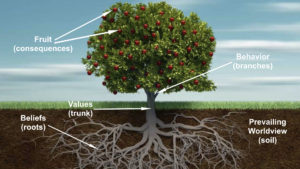
 This series is taking the metaphor of a tree and relating it to raising the next generation to think and act from a biblical worldview. We have identified several keys to growing healthy trees. These include:
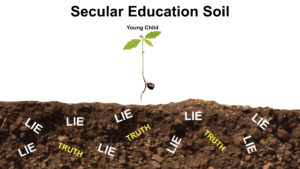 We have been looking at what it takes to grow healthy trees. Growing healthy trees is a metaphor for raising young people to be disciples of Jesus who can engage today’s postmodern culture by thinking and acting from a biblical worldview. In last week’s blog I asked the readers to identify some of the lies that are foundational to a secular worldview. These lies are what keeps people and societies in bondage. If we don’t identify them, we will not be able to break the chains that they have on our individual lives, families, churches and communities. Here is the list of lies that I posted last week. I have added some additional lies that various readers shared with me last week.

Recent Comments