

Category

Uncategorized

What Are We Preparing Our Children For?

By | Public Blog, Uncategorized

Over the past 2.5 weeks, I have had the privilege of conducting professional development seminars for nearly 700 administrators, teachers and parents from 15 different schools around the country.  During these sessions I asked a series of questions to which I received nearly unanimous answers.  As we discussed the purpose of education, I asked each group a simple question.  What does preschool education prepare the children for?  Without hardly any hesitation everyone in the session replied, Preschool education prepares children for kindergarten.  From this response, I concluded that parents and educators believe that all education is an effort to prepare children for something that they see as important in the future.  With everyone in agreement on this answer, I proceeded to ask a progression of additional questions.  Here are the questions and the answers I received.

  1. What does kindergarten prepare children for?  Answer:  Most said it prepared them for first grade while the others were more generic and said elementary school.
  2. What does elementary school prepare children for?  Answer: It prepares them for middle school?
  3. What does middle school prepare students for?  Answer:  Middle school prepares them for high school?
  4. What does high school prepare students for?  Answer:  High school prepares students for college?

Here is the conclusion I came to from these discussions.

The main purpose of schooling is to simply prepare students for more schooling!

I believe this is how most parents look at the education of their children and youth.  Parents send their children to school as early as possible.  Why?  So that they will be ready for more schooling.  In fact, if you ask parents if they want their children to get a good education, you will always get a strong YES.  However, when you ask them why they want their children to have the best education possible, the most common answer you will receive is so that they can get into a good college.  In other words, schooling has become an unending process of preparing our children for more schooling.  It is no wonder that so many graduates leave high school with no real purpose for their lives — other than to go to college.

When the purpose of schooling is to merely prepare a child for more schooling, the child fails to understand how he/she has been created by God for a purpose.  I have heard my friend, Pastor James McMenis, repeatedly saying, Every person is a PURPOSE with a name!

As a new school year begins across the US, I am challenging every reader to ask himself/herself a couple of questions?

  1. Am I simply trying to prepare my children/students for more schooling?
  2. What are some more meaningful purposes that should be the basis for how I educate my children/students?
  3. What do I need to change as I guide my children/students to understand their purpose as I teach them either at home or school?

Next week I will present a few goals that I believe must be the driving force behind the education we give our children and youth.  Please share your thoughts on this important topic below.

Created For Eternity

By | Public Blog, Uncategorized

I am amazed at how every person desires to live as long as possible.  Even the atheist wants to go on living though he says that he doesn’t fear death.  Whenever some disaster takes place such as hurricanes, earthquakes, or a terrorist bombing, every news station gives full coverage to the rescue efforts and the search for survivors.  Just recently there was daily news broadcasts that chronicled the rescue efforts of a boys’ soccer team that was trapped in a cave due to a flash flood.  This striving for life from when a newborn gasps for his/her first breath to when someone takes his/her last breath, the desire to live forever is a part of what it means to be human.

When God created man in His image, He did so by breathing into man His breath and man became a living soul.  Solomon, the wisest man that ever lived, talked about this unique characteristic of all human beings in Ecclesiastes.  In chapter 3, verse 11 we find these words.

 He has made everything beautiful in its time. Also He has put eternity in their hearts, except that no one can find out the work that God does from beginning to end. (NKJV)

In every human soul there is the awareness that there is something more than this life here on earth.  This is what gives man the hope that one day he can find fulfillment and satisfaction that is unattainable in this fallen world.  We must remember that man was never created to die.  Death was a result of the Fall.  However, even after sin entered the world, man still had that God-given awareness that he was designed to live forever.

Man was made for eternal things because we were created in the image of an eternal God.  Even though man was made for eternity, he cannot know what all God’s plan is from the beginning to the end. This is because man was made by the only eternal being — God, Himself.

Because every soul will live forever, it is important that we educate our children to know that there are only two options for where they will spend eternity — heaven or hell.  If we give them the best education possible and they find great success in life but don’t know Jesus as their Lord and Savior, their education is worthless.  A biblical worldview education is aimed at preparing them for both this life and eternity.  Our children must know that they were created for eternity and because of what Christ did on the cross, they can receive the gift of eternal life and know that they will spend eternity in His presence.

Created to Create

By | Public Blog, Uncategorized

Man has the amazing ability to create pictures in the mind and then bring into reality what was imagined.  We see man’s creativity in manufacturing, art, literature, music, humor and the common activities of everyday life.  Every parent has probably experienced what happens when he/she purchases a nice gift for a child only to find the gift set aside and the child playing with the box the gift came in.

Understanding man’s creative ability is a topic that has captured the thinking of sociologists, psychologists, educators and theologians for centuries.  The creative nature of man baffles those who try to convince us that man has evolved form non-creative beings over millions of years.

The reality is that our imagination and creativity comes from our Creator.  Since man was created in the image of a creative God, man is the only being that can imagine and then bring into existence what he imagined.  Our creativity is a reflection of the very creative nature of God.  Of course, God is the ultimate Creator and the only One who can create things out of nothing.  Man can merely take what God has created and use those things to create something new.

God expects man to use his creativity to fulfill what is referred to as the Cultural Mandate recorded in Genesis.

Then God said, “Let Us make man in Our image, according to Our likeness; let them have dominion over the fish of the sea, over the birds of the air, and over the cattle, over all the earth and over every creeping thing that creeps on the earth.”  So God created man in His own image; in the image of God He created him; male and female He created them.  Then God blessed them, and God said to them, “Be fruitful and multiply; fill the earth and subdue it; have dominion over the fish of the sea, over the birds of the air, and over every living thing that moves on the earth.”     Genesis 1:26-28 (NKJV)

God intended for man to use his creativity to rule over His creation as a steward.  However, with the Fall, man’s creativity would be used for both good and evil.  The creative mind of man developed such things as airplanes, computers and the cell phone.  However, man’s creative abilities were used to fly airplanes into the World Trade Center towers killing thousands; to use computers to transmit pornography into the minds of children, youth and adults at the mere click of a button; to use cell phones to captivate the waking hours  of life and destroy important relationships.

One of the most important uses of our creativity is found in man’s ability to create culture.  Darrow Miller in his book, LifeWork, states that God made humankind to be culture makers and it matters hugely what kind of culture we create.  Miller argues that God created man in His image desiring man to create a kingdom culture — culture that reflects the true nature and character of God.  Again, we must keep in mind that man will not automatically create this type of culture.  In fact, because of sin, man is bent toward creating culture that goes against the very nature of God.

We must remember that behind every educational effort there is some “god” that is feared, pursued and served.  This is a very important fact to keep in mind because the education we give our children will play a big role in determining what type of culture our children and youth will create.  Miller explains it this way.

Culture is a product of a people’s cult, or their civic religion.  It’s a reflection of the god they worship…culture is the temporal manifestation of a people’s faith…The cult [faith] leads to culture.  This, in turn, determines the kinds of societies and nations we will build.

In light of man’s ability to create, it is crucial that we provide our children and youth with a biblical worldview education.  This is our only hope to ensure that they will grow up to use their amazing ability to create for good and not for evil.  When we do this, our children and youth will be able to create a kingdom culture — a culture that will be created by image bearers of God reflecting His nature and character to a lost world.  What are we using our creative abilities to do when it comes to educating future generations?

Created to Work

By | Public Blog, Uncategorized

Today there are two dangerous extremes that people exhibit when it comes to looking at the topic of “work.”  One extreme is to view work as something evil and, thus, something to avoid as much as possible.  This view of work can be seen in how people dread Monday mornings, get some relief when “hump day” (Wednesday) comes and celebrate Friday’s with a shout of TGIF.  When work if viewed as something that is a burden, the goal of work becomes making enough money to retire comfortably as soon as possible.

The second extreme that many people exhibit when it comes to viewing work is the concept of defining your life by your work.  A person’s value is determined by what he/she does.  When people see work as what defines them, there is often a dissatisfaction with one’s job and a constant effort to “climb the ladder” of success.  Work dominates every waking moment and one is said to be a “workaholic.”

Either of these extreme views of work goes against the fact that God created man after His own image and, therefore, He created man to work.  Work has dignity because it is a reflection of who God is.  Throughout Scripture we see the fact that God is constantly “working.”  In Genesis, He performed six days of the “work” of creation.

Thus the heavens and the earth, and all the host of them, were finished.  And on the seventh day God ended His work which He had done, and He rested on the seventh day from all His work which He had done.  Then God blessed the seventh day and sanctified it, because in it He rested from all His work which God had created and made.  Genesis 2:1-3 (NKJV)

The Psalmist continually praised God for His “works.”

Say to God, “How awesome are Your works!…Come and see the works of God; He is awesome in His doing toward the sons of men.           Psalm 66:3,5

O God, You have taught me from my youth; And to this day I declare Your wondrous works. Psalm 71:17

Jesus also was known for His “works” while He lived on earth.

And when John had heard in prison about the works of Christ, he sent two of his disciples. Matthew 11:2 (NKJV)

In order to fully understand what it means to be human, every person must realize that God created man to work.  This is seen in Scripture by what is referred to as the cultural mandate in Genesis 1:28.  Here we find God telling Adam and Eve to …be fruitful, and multiply, and replenish the earth, and subdue it…  This is actually God’s job description to man.  Nancy Pearcey explains it this way in her book, Total Truth.

The first phrase “be fruitful and multiply,” means to develop the social world: build families, churches, schools, cities, governments, laws. The second phrase, “subdue the earth,” means to harness the natural world: plant crops, build bridges, design computers, and compose music. This passage is sometimes called the Cultural Mandate because it tells us that our original purpose was to create cultures, build civilizations—nothing less.

From his very beginning man was created to work.  One of the primary goals of education must be the effort to guide a child to understand the gifts and talents that God has created in him/her and to develop those talents and gifts.  When this is accomplished, the child can then become sensitive to God’s call on his/her life.  By answering God’s call on their lives our children can then perform work in order to fulfill God’s will for them.

The problem Christians face today is that we have lost the idea of vocation when it comes to work.  This loss has evolved over many years.  The progression that took place in how work is viewed goes something like this.

Work is God’s Call became Work is a job to be blessed by God which then became Work is a job to get ahead and is now seen as Work gives one the ability to consume.

Tim Keller wrote a powerful book, Every Good Endeavor.  In his book, Keller addresses the need to regain the concept of work being a vocation to which God calls a person.  He writes:

We must recover the idea that work is a “vocation” or calling, “contribution to the good of all and not merely…a means to one’s own advancement.”…To one’ self-fulfillment and power…Something can be a vocation or calling only if some other party calls you to do it, and you do it for their sake rather than your own.  Our daily work can be a calling only if it is reconciled as God’s assignment to serve others.

Kevin Swanson explains how a biblical view of work should guide the education of our children when he writes in his book, Upgrade: 10 Secrets to the Best Education for Your Child:

Everybody is gifted and has a purpose in God’s world…Each child has a specific calling, framed by his unique talents and abilities…The challenge of the first eighteen years of a child’s education is to find that calling…A fulfilled life will be determined by whether he/she has centered in upon his or her life calling…A successful education is achieved when a child is prepared to make maximal use of his God-given talents and abilities in the accomplishment of the child’s calling.

In his book, Designed for Dignity, Richard Pratt states:

By filling and ruling over the world, we fulfill our true purpose in life.  We reach the heights of dignity because we represent and extend the authority of the King of the universe.

Let me close with a statement made by Puritan theologian and writer William Perkins.  He wrote,

The main end our lives…is to serve God in the serving of men in the works or our callings.

There a couple of questions we need to answer.

  1. How do you view work?  Is it a burden or a blessing?
  2. How can your work be done in order to fulfill the cultural mandate?
  3. How are you modeling and teaching the next generation that man was created to work?

Created to Worship

By | Public Blog, Uncategorized

One of the most important aspects of understanding what it means to be human is to grasp the reality that God created man to worship.  When we hear the word worship today, many Christians immediately think of a style of music in the church.  However, worship has a much deeper meaning than just one part of a church service.  Webster’s 1828 Dictionary defines worship as to adore; to pay divine honor to; to reverence with supreme respect; to honor with extravagant love and extreme submission.  Another definition that combines all of these aspects of worship together states,

To treat someone or something with the reverence and adoration appropriate to a deity.

Man has an unending desire to want to worship something or someone.  This desire is rooted in the fact that God created man in His own image.  In doing so, God instilled into man a need to worship someone or something outside of man’s own physical existence.  When one reads about how God created man, he/she finds insight into this unquenchable desire for worship.

And the Lord God formed man of the dust of the ground, and breathed into his nostrils the breath of life; and man became a living soul.  Genesis 2:7 (NKJV)

Man was created distinctively different from all other creatures.  The distinctive difference is found in the truth that God actually breathed His supernatural breath into man.  The result is that man is a living soul.  Of course, this would cause Adam and Eve to only worship God prior to the Fall.  After the Fall, man was still a living soul.  However, with man being separated from God and man’s spirit dead in sin, man had a vacuum in his soul that must be filled with something.  Even though man is born a sinner, he still has a desire to worship.

God knows of man’s created desire to worship and that, because of sin, man will focus his worship on something or someone other than God.  Whatever is worshipped apart from God that cannot satisfy this longing.  That is why God’s first instructions to Moses was that Israel was to only worship God (Exodus 20:3-4).  When we think of idol worship in the OT, we think of images carved out of wood, stone or metal.  “Modern man” thinks that he is too sophisticated to worship mere tangible objects.  However, today man still worships false gods.  The objects of many Christians’ worship today are things like power, appearance, wealth/possessions and, even, education.  The truth of the matter is that every person has to worship something.

The reason why this is so important is that we will become like what we worship.  Lambert and Mitchell in their book, Reclaiming the Future, state,

…all people serve some ‘god’ or ‘gods’ in their lives and in turn are transformed into the image of their gods.

This truth is emphasized over and over again in Scriptures as is seen in this passage.

The idols of the nations are silver and gold, the work of men’s hands.  They have mouths, but they do not speak; eyes they have, but they do not see; they have ears, but they do not hear; nor is there any breath in their mouths.  Those who make them are like them; so is everyone who trusts in them. Psalm 135:15-18 (NKJV)

I recently read an article by Tim Tomlinson about how easy it is for man’s worship to become misplaced.  Tomlinson was reflecting on what took place around the world when rock music artist, Prince, died.  He stated,

His [Prince] death dominated the news at every level — nationally, regionally, and locally.  There have been hundreds of “live” reports given from the various locations associated with him.  Billboards throughout Minneapolis are paying homage to him by flashing his image and the symbols he used during his career to establish his “brand.”  Radio stations have interrupted their regular programming to play Prince music non-stop for days.  Interviews with weeping and distraught fans have been aired and printed in the local media.  There have even been god-like references made about him such as: “On Prince we trust” or “Hail to thee, Prince.”

The article went on to state,

What this all points to is our innate human desire to want to worship something or someone.  It is a God-given impulse that is good and right and satisfying — but only when it’s directed toward the one true God.

We say that, as Christians, we worship God, but do we?  If someone could only look at our calendars and checkbooks, would it reflect that God is the only focus of our worship?  When you and I evaluate what we think about the most and what captivates our imaginations, dreams and plans, would it point to true worship of God?  We cannot forget that the Bible is full of warnings about worshipping idols:

..if you by any means forget the Lord your God, and follow other gods, and serve them and worship them, I testify against you this day that you shall surely perish. Deuteronomy 8:19 (NKJV)

Are we guilty of idol worship?  Are we treating someone or something in our lives or in our schools with the reverence and adoration appropriate to a deity other than God, Himself?  We have been created to worship and what we worship, we will become!

A person will worship something, have no doubt about that.  We may think our tribute is paid in secret in the dark recesses of our hearts, but it will come out.  That which dominates our imaginations and our thoughts will determine our lives, and our character, therefore, it behooves us to be careful what we worship, for what we are worshipping, we are becoming.  Ralph Waldo Emerson

Created to Relate

By | Public Blog, Uncategorized

In order to fully grasp what it means to be created in the image of God, we must understand that God created man for relationship.  The doctrine of the Trinity is a crucial foundation stone of Christianity.  The Father, Son and Holy Spirit are three separate persons in the Godhead.  I cannot fully understand this reality with my finite mind.  However, I can understand that God is a relational God.  The Father, Son and Holy Spirit have always and will always be in perfect fellowship with one another.  In Genesis 1:26, the Father tells the Son and the Holy Spirit let us make man in OUR image.  Since God is a relational God and man is created in His image, then man was created to relate!
There is something inside each and every person that causes us to want to be with other people.  Loneliness is one of the leading causes of depression, addiction and suicide.  In fact, many of the people who have carried out horrific acts of mass murder, do so because of bullying that isolates them from meaningful relationships.  I find it intriguing that even when a person wants to do something wrong, he/she often wants others to join in with him/her.  Many of the Proverbs warn us about not joining in with others who want to practice wickedness.  Those who want to do wrong always are trying to entice us into joining them.

Of course, God’s first reason for creating man to relate is that we might enjoy a personal relationship with Him.  When Adam and Eve sinned, they hid themselves when they heard the voice of God walking in the Garden.  The Scriptures record that God was searching for them.

And they heard the voice of the Lord God walking in the garden in the cool of the day: and Adam and his wife hid themselves from the presence of the Lord God amongst the trees of the garden.  And the Lord God called unto Adam, and said unto him, Where art thou?  Genesis 3:8-9 (KJV)

Sin broke the relationship between God and man that was the fundamenta reason why God created man in the first place.  Even though Adam tried to hide from God, God searched for him and restored Adam into a relationship with Him.  This is the very reason why God’s Son gave His life on the cross for man’s sin.  It was to restore man’s relationship with God.  In fact, that is what eternal life is really all about.  It is not merely being saved from Hell and saved to Heaven.  It is about knowing God.

And this is life eternal, that they might know thee the only true God, and Jesus Christ, whom thou hast sent.  John 17:3 (KJV)

Not only does God want to have a relationship with every one of us, He also wants us to live in fellowship with each other.  Man is not designed to live life alone.  In fact, after God had declared His creation to be very good, He stated that something was not good.

And the Lord God said, It is not good that the man should be alone; I will make him an help meet for him. Genesis 2:18 (KJV)

God then formed Eve out of Adam’s side so he could live in relationship with his wife.  Marriage, the family, church and community were designed by God for relationships to flourish.

When Jesus was asked what was the most important commandment in life, His answer gives priority to the fact that being human means understanding that we were created to relate.

Master, which is the great commandment in the law?  Jesus said unto him, Thou shalt love the Lord thy God with all thy heart, and with all thy soul, and with all thy mind.  This is the first and great commandment.  And the second is like unto it, Thou shalt love thy neighbour as thyself.  On these two commandments hang all the law and the prophets. Matthew 22:36-40 (KJV)

To be human is to understand that we were created to reflect and to relate.  Here are a couple of questions that I have to ask myself on a regular basis.

  1. Is my relationship with God a true measure of how He created me to relate?
  2. How does my relationship with my wife demonstrate that I have been created to relate?
  3. How does my relationship with my children show them what it means to be created in God’s image?
  4. Do I love all people as I love myself?
  5. How does understanding that I have been created in the image of God for relationships answer many of the issues facing society today?

The Importance of Having a Kingdom Focus

By | Public Blog, Uncategorized

In preparation for a sermon I had to preach this past weekend, I was studying some of the key concepts that Dr. Ken Hemphill wrote about in his book, EKG: The Heartbeat of God.  I was reminded that Jesus declared that the kingdom of God must be our highest priority in our lives, homes, churches and schools.

But seek ye first the kingdom of God, and his righteousness; and all these things shall be added unto you. Matthew 6:33 (KJV)

In order that we may seek His kingdom, we must first understand what His kingdom is.  Hemphill explains God’s kingdom in a very understandable way.

The kingdom of God can be understood by realizing that He is our King and we are His people that He is our Master and we are His servants that He sets the rules and we simply obey.

Simply stated God’s kingdom is present wherever and whenever God reigns.  God wants to reign supreme in all of life — whether it is in the life of an individual, a family, a church or the education of one’s children.

The heartbeat of God is for His kingdom to grow.  Throughout human history God has accomplished and continues to accomplish this through a select group of people that He takes as His possession.  In the Old Testament, God chose Israel to be His possession (Exodus 9:16; 16:5).  In the New Testament, He chooses individuals or we could say the church in general (Titus 2:14).  It is important to keep in mind why God chooses nations and/or individuals to become His possession.  I again refer to what Hemphill writes in his book.

God has a claim on His people (Israel, today’s church) not just to give His people privilege or standing but to give them purpose. As His possession we are not to be admired on the shelf but to be maneuvered full force into the world.

God has chosen us, as Christians, to accomplish two purposes through our lives.

  1. God wants His people to be known to the world as demonstrated by their relationship to Him.
  2. God wants His people to fulfill their roles in all of life in order to extend His kingdom rule in the world.

God always desires to demonstrate to the world what living in a covenant relationship with Him would produce in people’s lives.

The blessings God promises to bestow upon His people were and are never intended to glorify the people but to showcase His goodness so that all the nations would be drawn to Him through His people. Ken Hemphill

This is why He demands His people to be holy (1 Peter 1:16).  Holy means to be set apart.  Our lives should be set apart from the world in our:

  • worldview or beliefs
  • speech
  • lifestyle or behavior

This concept is also applicable to the education we give to our children and youth.  Their education must be different from the secular education that this world provides.  The difference must be evident in the school’s philosophy and the worldview from which all teaching takes place.  However, we are facing a crisis in today’s homes, churches and schools.  Hemphill accurately describes our current crisis this way.

Ours is a world where we are too often lured into being near carbon copies of our culture – Christian up to a point yet cool enough to know when we are taking it too far.  We are rewarded with the world’s acceptance when our tastes and standards look more like the prevailing norms and less like the prescribed Word of God. We feel a little bit more comfortable when we fit in.

Unfortunately, I find this very same situation infiltrating too many Christian schools.  There seems to be an effort to “fit in” with secular forms of education.  We offer the same courses, use the same textbooks and basically follow the traditions of men that Paul warned against in Colossians 2:8.  The challenge Christian parents, church leaders and educators face is that it is easier to be traditional than it is to be biblical.

I was reminded of the power of what might be referred to as the “hem of holiness”.  We find these words in Zechariah 8:22.

Thus saith the Lord of hosts; In those days it shall come to pass, that ten men shall take hold out of all languages of the nations, even shall take hold of the skirt of him that is a Jew, saying, We will go with you: for we have heard that God is with you.

This is an amazing statement.  There will be a day when people from every nation and language will cling to God’s people and beg to go with them.  Why?  It will be because they heard that God is with them.

As another school year comes to close here in this country and we start preparing for a new year, I believe it is important that we take some time and reflect on God’s call on our lives, our homes, our churches and our schools.  In light of what I have shared above, there are some questions that we need to consider.
  1. Do we desire the kingdom of God or the kingdoms of the world?
  2. Are we striving for personal/school fame or for the Father’s glory?
  3. Are our homes, churches and schools known by our relationship with God?
  4. Do we see and have we accepted our roles as leaders to extend the rule of the King?  If so, where”?  In whom”
  5. Are families coming to our schools and urging us to allow them to join and go with us because they have heard and seen that God is with us?

God still wants a people of His own who will:

  1. Embrace His mission — be God’s chosen instruments to draw the lost to Himself.
  2. Embody His name — represent His nature and character to the world.
  3. Obey His Word — have a brand of holiness that demonstrates all the noticeable difference He makes in lives.

Strengthening One’s Authority

By | Public Blog, Uncategorized

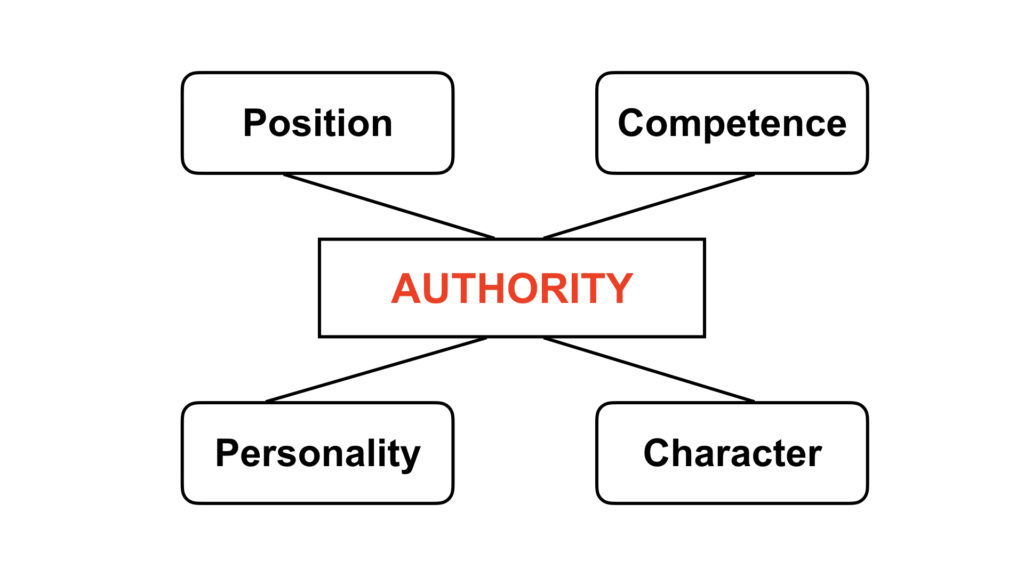
It is important that parents, church leaders and educators understand the importance of effectively exercising their authority.  Many years ago I read about what makes up one’s authority in any given situation.  The writer explained that there were four components to one’s authority or one’s power and right to command and exact obedience.  These four components that make up a person’s authority were positioncompetencepersonality, and character.  As I thought through these four components of authority, I drew a model like the one below.

Position

When a person is placed in a position of authority, he/she is given the authority needed to fulfill the responsibilities of the position.  For example, when I was placed in the position of high school chemistry teacher, I was also given the authority of a teacher to exercise in fulfilling the responsibilities of this assignment.  The same was true when I was named a coach, a high school principal, a superintendent and even became a parent.

It is important to understand that I was only given the authority that was respective to the position I was placed in.  As a teacher, I was not given the authority of a principal.  As a coach, I was not given the authority of the owner of the team.  Positional authority is constant as it is related only to the position a person has been placed in.

Competence

Competence can be defined as the ability to do something successfully, efficiently and effectively.  When I first became a teacher, I was not very competent in the act of teaching.  I never had any teacher training nor did I ever do student teaching.  If I wanted to gain greater authority in my students’ lives, I had to improve my competence as a teacher.

This was really driven home to me in my first varsity coaching experience.  The players responded pretty well to my directions but mostly

because they wanted to be on the team and get playing time.  They didn’t know anything about my basketball knowledge or ability.  This changed when a couple of the players asked me to participate in little pickup game after a practice.  I agreed and thought this would be fun to get out on the court with the guys.

It turned out that they had arranged the game in order to see what I really knew about the game of basketball.  They played pretty rough and eventually caused me to push my “competitive button”.  It wasn’t long before my college playing experience and abilities kicked in and dominated them.

The next day in practice the entire team gave me a much greater effort in every drill and aspect of practice.  I learned that my authority as a coach had increased.  This greater authority was not due to my position — I was still the coach.  However, my competence as a basketball player had increased significantly due to a little pickup game after practice the night before.

Personality

When the author talked about the influence of one’s personality as it relates to one’s authority, he was not talking about being an extrovert or introvert, or a “D” or an “S”, or a “golden retriever” or a “beaver”.  We have all taken some type of personality inventory and have been categorized in some way or another.

The aspect of personality that influences the degree of authority one might possess is related to the person’s openness or closeness.  Here it referring to how approachable are you to those who are under your authority.  This is not about being “buddies” with people.  It is about developing your personality where those you are leading can come to you and talk about a success or failure, an idea or a concern, or something that created an offense with them.

Again, this component of authority is under the leader’s control.  Anyone can improve his/her authority by working on developing relationships that allow others to approach you without being fearful.  This is very important in parenting.  If we do not exercise our parenting authority properly, it can drive our children away from bringing issues they may face in their lives to us.  Instead, they end up going to their peers or the world to get their answers to life’s questions.

Character

Character, when it comes to being a good steward of one’s authority, can be defined as one’s credit rating with people!  We all know how important it is to maintain a good credit rating when trying to purchase a house or something similar.  A poor credit rating costs a person greatly.

This is also very true when it comes to the exercise of one’s authority.  If we are not trustworthy and honest with those we are trying to influence, it will hurt our ability to exercise effective authority over them.  We must develop a strong credit rating with our children and/or students.  We must live lies of integrity where we actually do what we say we will do.

Let me try and bring all of this together.  Last week I shared how I believe that any authority I might have in life is actually given to me by God.  Therefore, He expects me to develop and invest the initial authority that He gives me so that it will bring gain to the Lord.  Again, it must be understood that authority is a stewardship responsibility.

As I shared with you the components that make up any authority we might be given in life, we must grasp the reality that there is only one component of one’s authority that he/she as no control over.  That component it the authority one has because of one’s position.  A teacher only has teacher authority.  He/she does not have administrator authority because he/she does not have the position of an administrator.

Every person, however, has control over the other three components that make up one’s authority.  It is each person’s responsibility to develop and strengthen his/her competence, personality and character in whatever position one find’s himself/herself.  An example may be helpful in making my case.

When I first became a parent, God gave me enough parental authority to handle a newborn child.  God also knew that I would need greater parental authority to direct and guide my children when they became teenagers.  That meant that I need to become more competent as a parent.  I also needed to develop an open personality that would allow my children to approach me with any problem or issue that they were facing.  It was also very important that I strengthened by character or credit rating with them if I expected them to respect my authority and submit to my guidance.

Unfortunately, I have seen parents who never developed and strengthened their parental authority that God gave them when they first became parents.  It wasn’t that they necessarily weakened their parental authority.  They basically did nothing to strengthen it.  They were like the unjust steward who hid his master’s talent in the ground.  The result that comes with not strengthening one’s authority is that that person can actually lose any influence over the ones that God wanted them to lead.  Sometimes a parent’s authority is taken away and given to another person or group.

Here are some questions we must answer as we attempt to be effective leaders and teachers of the next generation.

  1. What position(s) of authority has God given to you?
  2. What have you done or need to do to strengthen your competence related to the position(s) God has given you?
  3. How can you be more approachable as a person in authority to those you are leading?
  4. On a scale of 1 to 10 with 10 being the highest, what credit rating would you give yourself in the various positions of authority God has placed you in?  What can you do to raise your credit score in each position?

Be sure to share your comments about this post or any of the posts related to authority and submission that I have covered over the past several weeks.

Authority: A Stewardship Responsibility

By | Public Blog, Uncategorized

I have been highlighting the issue of authority and submission to authority in several of my recent blogs.  I am giving so much attention to this subject because I believe it is so essential to Christians living a life that is pleasing to God.  After all, every person is under some authority and everyone exercises some authority over someone else in some way or another.

When trying to understand authority, it is important to define the term accurately.  I have used a couple of definitions to help me understand this all-important area of life.

Authority is the right or power to command and exact obedience and/or an accepted source of expert information.

Once authority is defined accurately, it is then important to put one’s authority in the proper perspective.  When I consider authority, I see it as a stewardship responsibility from God.  Again, it is important that we have a clear understanding of what stewardship is.  Stewardship is defined in the dictionary as:

The careful and responsible management of something entrusted to one’s care.

In order for something to be entrusted in to one’s care, someone else must first own that something.  That person must have the power to give what he/she owns to another person’s care.  When I considered the many aspects of stewardship found in Scripture, I defined stewardship this way.

It is the use and/or management of something that an owner gives to me in order for the owner to receive gain or profit.  

Another way of putting this is what someone posted online.  The person made this statement.

Stewardship is the maximizing God’s blessings for His glory!

This is clearly the concept that one finds when reading the parable of the talents in the gospels.  The owner gave certain amounts of his talents to three servants.  The servants who managed the owner’s talents and produced a profit for him were praised and rewarded.  However, the one servant who did nothing with the owner’s property and simply returned what he had been given back to the owner was criticized and lost everything.

Based on these definitions, I believe that authority, when properly understood, becomes a stewardship responsibility.  Christians believe that God is the creator of the universe and is sovereign over all things.  God is literally the owner of everything that exists in both heaven and earth.  This means that He has ultimate authority over everything.  He, alone, has the right and power to command and exact obedience from the entire created universe.  He not only has the authority over all people but also over all of creation.  This is seen when Jesus told the wind and the waves to be still and they obeyed.  It can be said that God is authority!

No matter how much authority I might attain, I must always realize that I am not in charge.  God is the only One who is sovereign and has all authority.  Jesus made this clear when He stated,

And Jesus came up and spoke to them, saying, “All authority has been given to Me in heaven and on earth. Matthew 28:18

Who has given Jesus all authority?  It is God the Father who has done this.  The Father can do this because He is the supreme ruler of all things.  Consider these verses.

[God] brings princes to nothing, and makes rulers of the earth as emptiness.  Isaiah 40:23

O Lord, God of our fathers, are you not God in heaven?  You rule over all the kingdom of the nations.  In your hand are power and might, so that none is able to withstand you.  2 Chronicles 20:6

The Lord has established His throne in heaven, and His kingdom rules over all.  Psalm 103:19

Scripture also makes it clear that God gives a portion of His ultimate authority to man.  Consider the following verses.

Let Us make man in Our image, according to Our likeness; let them have dominion over the fish of the sea, over the birds of the air, and over the cattle, over all the earth and over every creeping thing that creeps on the earth…Be fruitful and multiply; fill the earth and subdue it; have dominion over the fish of the sea, over the birds of the air, and over every living thing that moves on the earthGenesis 1:26-27

The heaven, even the heavens, are the Lord‘s: but the earth hath He given to the children of men. Psalm 115:16

Since God “owns” or “is” authority, any authority I might possess has to have been given to me by God.  In line with all the other stewardship responsibilities that God has given me, I must use, manage, and/or invest my authority in such a way that it will bring Him gain or profit.  This is in essence what it means to glorify God.  The stewardship of my authority as a parent, teacher, administrator, church member, etc. must be exercised in such a way that it brings Him glory.

Here are some question that come to my mind when I think about the authority that God has given me.  How would you answer them?  Better yet, how would those whom you have authority over answer these questions?

  1. Have you looked at any authority you might have as being given to you by God?
  2. Since any authority you have has been given to you by God, what are some of the ways that you should exercise that authority so that God will be glorified?
  3. In what ways have you been a poor steward of the authority God has given you in some area(s) of life?
  4. What are some things you will do in the future as you steward the authority that God has given you?

I always appreciate your comments that you can leave below.  Next week I am going to share a model of authority that has helped me be a better steward of any and all authority God has given to me.

Exercising Authority

By | Public Blog, Uncategorized

Over the past couple of weeks I have attempted to address the issue of authority and subjection from a biblical perspective.  So far, we have seen how authority is set in place for the purpose of function not importance.  Anyone who finds himself in a position of authority is not to think more highly of himself than those he is leading.
We also looked at how submission to authority is not a negative thing but something that is good.  This is because even Jesus lived a life of full submission to His Father.  In fact, the degree to which I submit to the authority God places over me determines how Christlike I am becoming.

Since God establishes authority which, in turn, requires submission to authority, why is there such a problem with all of this throughout civilization?  All one has to do is look at what is going on in governments around the world or in everyday life to see that there is constant resistance, rejection and even rebellion to any and all forms of authority.  The answer to this dilemma is two-fold.

First, we must understand that because of the Fall, the flesh never wants to submit to any authority.  The flesh wants to be completely autonomous.  This is what led to sin in the first place.  Adam rejected God’s authority in his life and chose to do what he thought to be best.  Sinful man’s condition can be summed up in the phrase that is found throughout the book of Judges.

In those days there was no king in Israel; everyone did what was right in his own eyes.        Judges 17:6

No one wants a king in his life.  I believe that is why people will continue to believe in evolution when everything in the universe shouts of a creator.  If man admits that there is a supernatural being who created everything, then man must also admit that he is accountable to Him.

The second reason why I believe that just about all institutions of authority are being rejected has to do with how people exercise their authority.  This is true in the family, church, education, government and society in general.  The Bible speaks a great deal of how important it is for people to submit to authority.  However, many Christians don’t give much heed to what the Bible says about how one is to exercise his/her authority.

Over the past few years, I have given a great deal of thought into a very familiar passage of Scripture.  I have found this verse to have significant meaning on just about every aspect of my life.  I am sure you probably have memorized this verse and quoted it at one time or another.

Do not be deceived, God is not mocked; for whatever a man sows, that he will also reap. Galatians 6:7


Too often, we apply this to what happens when we commit sin.  If we sow to the flesh, we will reap corruption.  However, I have been convicted lately about the fact that this verse applies to every aspect of my life.  Being a teacher and a coach, I always wanted my students to pay attention to what I was presenting in a lesson or trying to execute in a practice.  I would get frustrated and sometimes angry if students weren’t paying attention or not putting forth the expected effort.

Then I was confronted with how I was paying attention or putting forth effort when listening to the preaching of God’s Word in a church service or sitting in a lecture or some staff development training in my job.  I had to admit that many times I didn’t pay attention the way I should have.  This was especially true when I found myself thinking that what someone else was saying wasn’t what I thought was all that important.  The thought hit me that when my students didn’t pay attention to me was I simply reaping what I had sown when I was in the role of being a student?

So it is with the exercise of one’s authority.  I will reap the consequences of what I sown in how I exercise any authority that God gives me.  If I “lord it over” those I am to lead, then I will reap anger and resistance from them.  If I am always “threatening” others, I will reap a challenging spirit from those I am trying to lead.

God taught me a very valuable lesson related to how He expects us to exercise authority that He gives us.  I was teaching a Bible ethics class at a Christian school.  We were studying a series of biblical principles that were to guide us in making decisions.  Everything was going fine until we got to the principles of authority and submission/obedience.  As soon as I announced the topic the students reacted negatively.  Their mindset was that is all they ever hear — obey, obey, obey!

I knew that they needed to understand authority and submission/obedience if they were going to go out and live successful lives.  I took them to two passages of Scripture and asked them a question related to each verse.  These two verses were:

…ye fathers, provoke not your children to wrath: but bring them up in the nurture and admonition of the Lord. Ephesians 6:4

Fathers, provoke not your children to anger, lest they be discouraged. Colossians 3:21

Here are the two questions that I asked them.

  1. What does your authority [parents] do that causes wrath in your life?
  2. What does your authority [parents] do that brings discouragement in your life?

Their answers were convicting.  They told me that when someone in authority is dictatorial or authoritarian in how he/she exercises their authority, it created anger and wrath in their lives.  The attitude that says I am the boss, do what I say, because I say so resulted in angry reactions from these students.

Then they told me that what caused discouragement in their lives was when people in authority were too lenient.  This answer was surprising so I asked them to explain it.  Students explained when people in authority were not willing to set clear boundaries and hold them accountable to staying within those boundaries, they believed that their authority didn’t care about them.  They got the sense that their authority, many times their parents, wanted to be “liked” by them and were more interested in their own comfort rather than the good of the child.

Both of their responses dealt with “how” one exercises his/her authority — not with the fact that they “had” authority over them.  There are several passages of Scripture that gives us guidance in how we are to exercise authority over those we are to lead.  It would be good if we studied these passages and lived them out in our daily interactions with others.  I have listed some of the passages I have found helpful.

  • Matthew 5:3-11 – the Beatitudes which I see as “the attitudes it takes to be something in God’s kingdom.”
  • Ephesians 6:9
  • 1 Peter 5:1-3
  • Mark 10:36-45
  • Colossians 4:1

What do these verses tell you about how you are to exercise your authority?  What other verses have you found helpful in being a servant leader?  Leave your comments below.